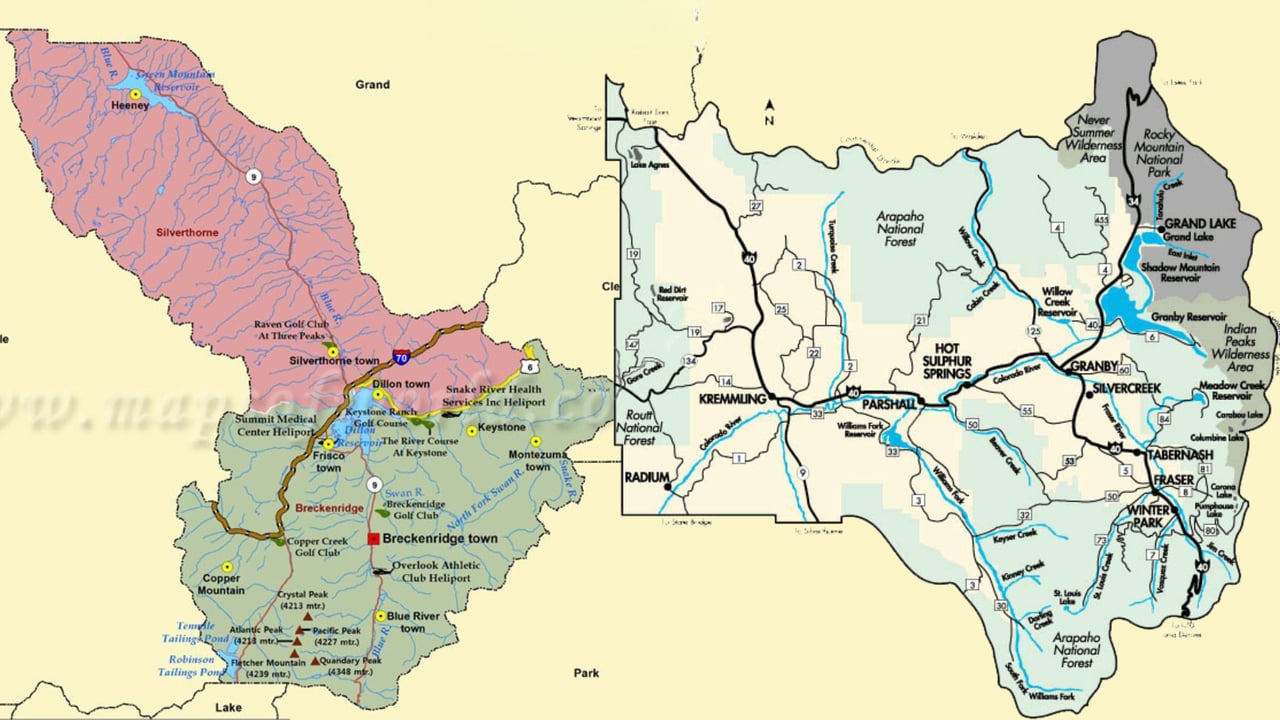
If you’re trying to decide between Summit County vs. Grand County for a short-term rental, you’re not alone. These are two of the most searched mountain markets in Colorado for second homes, Airbnb properties, and vacation rental investments — and while both offer strong lifestyle appeal, they are not equal when it comes to entry price, short-term rental friendliness, and long-term upside.
For many buyers, Grand County stands out as the more compelling short-term rental opportunity right now: generally a lower price point, more room for appreciation, and a regulatory environment that is often easier to work with than parts of Summit County. Grand County also benefits from major long-term growth drivers tied to Winter Park, including the broader Winter Park Unlocked redevelopment vision and continued rail access from Denver via the Winter Park Express.
Why investors compare Summit County and Grand County
Both counties attract year-round visitors looking for skiing, hiking, biking, lake time, festivals, and mountain-town getaways. Both also have established vacation rental demand. But for an investor, the real question is not just, “Which county is more popular?” It is:
Which market gives me the best mix of:
-
purchase price
-
STR usability
- guest demand
-
future appreciation
-
and manageable competition
That’s where the conversation gets interesting.
Summit County: strong brand recognition, but tougher entry and tighter constraints
Summit County includes nationally known destinations like Breckenridge, Keystone, Dillon, Frisco, and Silverthorne. There is no doubt that Summit has strong tourism demand and broad name recognition. For many buyers, it is the first Colorado mountain market they think of.
But from an investment standpoint, Summit often comes with more friction.
In unincorporated Summit County, short-term rentals require a license, and the county separates properties into different regulatory buckets such as Resort Zones and Neighborhood Zones. The county also maintains an STR waitlist, and states there is no estimated time frame for when licenses may become available in some cases. Summit’s official STR pages also note that all properties in unincorporated Summit must be licensed before they can advertise or operate.
That matters because investors do not just buy views — they buy usability.
In plain English: Summit can still be a great market, but depending on the location and property type, it can be more expensive to enter and more restrictive to operate.
Grand County: more investor-friendly in the ways that matter
Grand County includes Winter Park, Fraser, Tabernash, Granby, Grand Lake, and the surrounding Fraser Valley. For short-term rental buyers, it often hits a sweet spot: mountain lifestyle, strong tourism appeal, and a lower entry point than many competing resort counties.
In unincorporated Grand County, owners who want to short-term rent must obtain a permit, and the county’s current framework is based on an annual STR permit process. The county also recently announced amendments to its STR zoning regulations in January 2026, which is a good reminder that investors should always verify current rules before purchasing.
What makes Grand County attractive is not that there are no rules — there are — but that many buyers still see the county as more workable and more opportunity-rich than tighter, more mature resort markets. There are less restrictions here compared to other counties in Colorado.
1) Lower purchase prices can mean a better entry point
One of the biggest reasons buyers search for Grand County short-term rentals over Summit is price. In general, Grand County offers more approachable price points than Summit County for comparable mountain-lifestyle properties.
That lower basis can matter in several ways:
-
lower cash needed to get in
-
potentially better ability to furnish and launch the property well
-
more flexibility in your monthly carrying costs
-
a better shot at buying for both enjoyment and long-term equity growth
For many buyers, the question is not just “Where can I make the most gross rental revenue?” It is also “Where can I buy without overextending myself?”
Grand County often answers that question better.
2) Grand County still feels set up for growth
This is a huge piece of the story — and one investors should not ignore.
Winter Park and the surrounding Fraser Valley are not static markets. The Town of Winter Park describes Winter Park Unlocked as a major redevelopment initiative tied to resort evolution, public amenities, connectivity, and a gondola connection between downtown and the resort. Town materials describe the plan as part of a broader long-term growth and infrastructure effort, while the Town has also referenced Alterra’s roughly $2 billion redevelopment vision and 350+ acres of new skiable terrain.
That kind of planned investment matters because it can support:
-
stronger year-round visitation
-
better guest experience
-
more employer and infrastructure growth
-
and potentially stronger property values over time
Investors are not just buying what Winter Park is today. They are buying what the market may become over the next several years. A true ski town with walkability between the resort and downtown like Breckenridge or Telluride.
3) Rail access is a real differentiator
Another reason Grand County gets serious attention from investors is accessibility.
Amtrak’s official Winter Park Express page says the 2025–2026 season includes service every Friday, Saturday, and Sunday beginning December 19, 2025, with Thursday-through-Sunday service beginning January 8, 2026, through March 29, 2026. Amtrak also notes continued service between Denver and Winter Park, and recent materials highlight growing ridership and the Fraser stop.
That is a meaningful advantage when you market a vacation rental. Plus, daily train service to and from Denver will begin November 2026. Stops include the resort, Fraser and Granby. Leave a car in the mountains and take the train to and from Denver to avoid i-70 and Berthoud Pass.
A property that can appeal to guests who do not want to drive I-70 every weekend has a different value proposition. For Front Range travelers especially, ease of access can influence booking behavior.
4) Year-round demand is part of the investment case
Grand County is not just a ski play.
Yes, Winter Park Resort is the anchor, but Grand County also offers warm-weather demand drivers: hiking, biking, golf, lakes, fishing, national forest access, and proximity to Rocky Mountain National Park via Grand Lake. That broader four-season appeal can help investors diversify their guest profile beyond peak winter weekends.
Summit has year-round appeal too, of course. But Grand County’s combination of recreation, lower barriers to entry, and growth narrative is exactly why more buyers are starting to look harder at it.
5) Grand County can offer more room for equity building
This is one of the most important takeaways for investors.
Summit County is already highly established. That can be a positive — but it can also mean you are buying into a market where a lot of the appreciation story is already priced in.
Grand County, by contrast, is often where buyers see more runway.
That does not mean guaranteed appreciation. No market works that way. But if you are searching for:
-
a lower acquisition price
-
a market with major planned investment
-
continued tourism appeal
-
and a county that remains highly relevant to STR buyers
then Grand County is often the market that feels more aligned with equity-building potential.
So which county is better for a short-term rental?
Here’s the honest answer:
Summit County may be better if you want:
-
immediate brand-name recognition
-
high-traffic resort visibility
-
a more established luxury tourism market
-
and you are comfortable with higher entry costs and tighter rules in some areas
Grand County may be better if you want:
-
a lower price point
-
a market that is still growing into its next chapter
-
strong short-term rental appeal
-
easier access from Denver for many guests
-
and a better chance to balance lifestyle use with long-term upside
For a lot of buyers I work with, Grand County wins the conversation.
Not because Summit is weak — it is not — but because Grand County often offers the better blend of affordability, STR viability, and future growth potential.
Final thoughts: Grand County is worth a serious look
If you are comparing Breckenridge vs. Winter Park investment property, Summit County vs. Grand County Airbnb, or searching for the best Colorado ski town for a short-term rental, Grand County deserves to be on your shortlist.
It is one of the more compelling mountain investment markets for buyers who want:
-
a vacation home they can actually use
-
short-term rental potential
-
less punishing entry prices than some competing ski counties
-
and a market with real momentum
The biggest mistake I see buyers make is focusing only on popularity. The better move is to focus on where the combination of price, policy, demand, and future growth still makes sense.
Right now, Grand County belongs in that conversation. Reach out to me directly with any questions!